
Problem
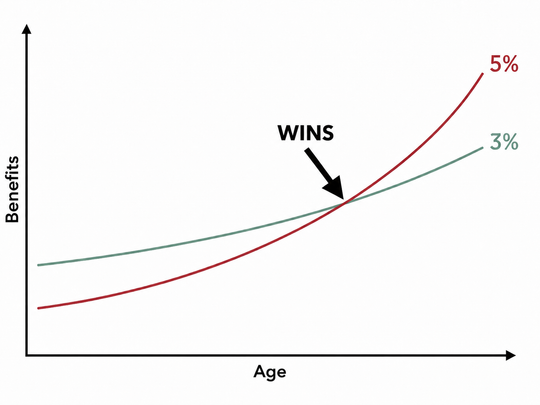
Many higher-net-worth clients can absorb an average long-term care event out of pocket but don't want to pay for eight or more years of memory care. Elimination periods are capped at 365 days, which limits how much of a "deductible" can be built in. That leaves benefit growth design as the primary lever for shifting coverage toward the long tail.
Solution
A OneAmerica Asset Care plan design can offer lifetime coverage with back-loaded inflation, concentrating benefit growth in the later claim years when cumulative costs are highest.
Quotes
Below are two sets of quotes comparing a typical 3% benefit growth design to split-growth designs: 0% in years 1–2, then 3% or 5% thereafter.

The middle option (B) shows what happens when you redirect year-one benefits into later-year compounding at the same rate. Option C pushes that further by compounding at 5% once it kicks in. Compared to Option A, Option C produces 65% higher monthly benefits from claim year 3 onward at age 80 ($12,211 vs. $7,397) for the same $100k premium, concentrating coverage in the later years when cumulative costs are highest.

At age 60, Option F still provides 42% higher benefits from claim year 3 onward than Option D ($6,603 vs. $4,639), even with fewer years for compounding.
Is this enough coverage?
Assisted living averaged $6,200/month nationally in 2025 and has grown roughly 4.5% annually over the past two decades. Projecting forward to age 80, Option C's monthly benefit covers:
- Buy at age 50: 50% of projected assisted living costs ($12,211/mo vs. ~$24,300/mo)
- Buy at age 60: 42% of projected assisted living costs ($6,603/mo vs. ~$15,600/mo)
Memory care and skilled nursing typically run higher than assisted living. Insurance benefits stay the same regardless of care setting, so higher-acuity care simply means more out-of-pocket supplement from existing assets and income.
Is insurance worth it?
Consider a 50-year-old couple where one person needs care at age 80 for 10 years.

In this scenario, total out-of-pocket costs are reduced by $1.64 million. Conditional on a claim beginning at age 80, that equates to roughly a 10% IRR on the $100k premium, with benefits paid income tax-free. In a 25% bracket, the tax-equivalent IRR is closer to 13%.
It's worth comparing that return to a "safe" fixed-income benchmark rather than equities. The alternative isn't an all-stock portfolio, it's the portion of the client's assets they'd need to keep liquid and conservative to self-fund a potential care need.
Takeaway
A back-loaded Asset Care design concentrates benefits where the long-tail risk actually lives. For a 50-year-old couple funding a $100k single premium with a 0% → 5% split-growth design, monthly benefits at age 80 are 65% higher in the later claim years than a typical 3% design. Clients self-fund the early, lower-cost years and redirect premium dollars to the tail, with lifetime coverage that doesn't run out if the long event happens.
Next steps
If you're an advisor and want to see what this looks like for a specific client, email me their age, marriage status, state and any other details and I'd be happy to run quotes.