

Joseph and Lora,
Your long-term care insurance quotes are ready.
First, please watch this short video I made for both of you:
🔎 Your quotes
I’ve provided three quotes, each with an initial benefit of $6,000 per month, to allow for an apples-to-apples comparison. My goal is to help you self-fund early care while maximizing coverage for later, longer-duration claims.
8/14/26 update: I added Options D and E to show policies with shorter benefit periods designed to cover more typical care durations.

🧐 My notes
All three options are strong and among the most popular policies on the market.
Option A: This traditional policy from Mutual of Omaha offers each partner 7 years of benefits, starting 365 days after care begins.
- If Partner 1 exhausts their benefit pool, they can begin using Partner 2’s benefits.
- If Partner 1 passes away, any unused benefits from their policy transfer to Partner 2.
Option B: This traditional policy from NGL (National Guardian Life) offers each partner 6 years of benefits, plus an additional 6 years that can be used by either partner. Benefits start 180 days after care begins.
Option C: This hybrid policy from OneAmerica offers lifetime benefits, a small refund to heirs if care is never needed, and a unique way to self-fund and boost benefits.
Benefits stay level for the first two claim years, then grow at 5% annually. This effectively creates a larger self-funded “deductible” upfront, with your assets covering more of the early claim years while preserving more insurance for later years and strengthening long-tail coverage.
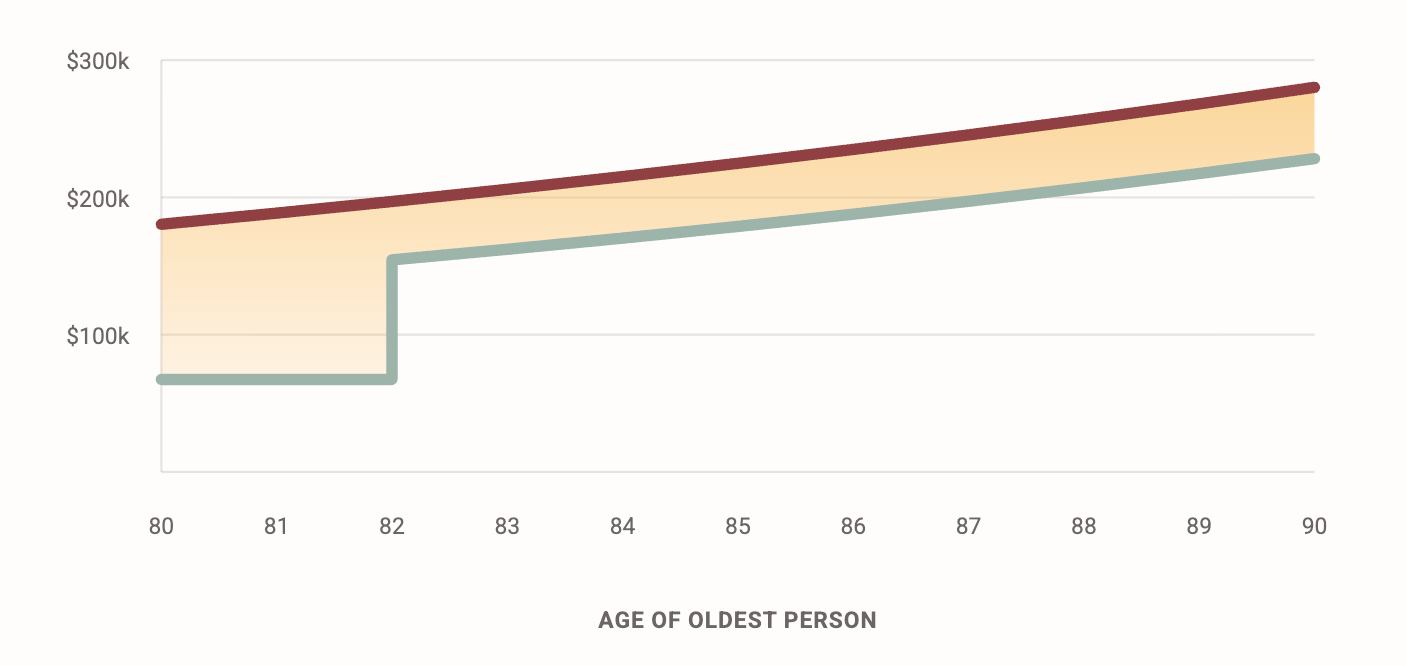
Update 8/14/26:
Option D: This traditional NGL policy, from the same policy as Option B, provides each of you with 3 years of benefits with the lowest premium. Benefits begin after a 180-day elimination period, compared with the more typical 90 days.
Option E: This Nationwide hybrid policy provides 6 years of shared benefits, paid in cash. If you do not use the policy for care expenses, it provides a $216,000 refund.
These policies provide lower annual benefits than the projected cost of care in Massachusetts, but you can bridge the gap using personal savings and Social Security. For most people, the goal is to secure meaningful coverage rather than insure every dollar of potential care costs.
You can also adjust the benefit amount to fit your budget. For example, reducing the premium by 25% would generally reduce the benefits proportionally.
💡 Big Picture: I prefer Option B over Option A because it offers comparable benefits at a lower premium. Option C offers the best blend of self-funding and insuring against the long tail of potential care costs. Option D offers the lowest annual cost and option E offers the highest refund if you don't need care.
👉🏻 Next steps
Reply to my email or text with feedback or schedule time on my calendar to review these options together.
Alternatively, complete this longer health pre-screen form (15 minutes) for more clarity on your options. I’ll share your answers with insurers without your name attached to get informal feedback. This helps identify which policy is the best fit and avoids the risk of a formal decline.
Thanks,
Jesse
P.S. Still learning? See our popular blog or YouTube channel.